 Alerua
Doppler radar
How Doppler radar works
How the radar measures wind, what green and red mean, and where the reading breaks down.
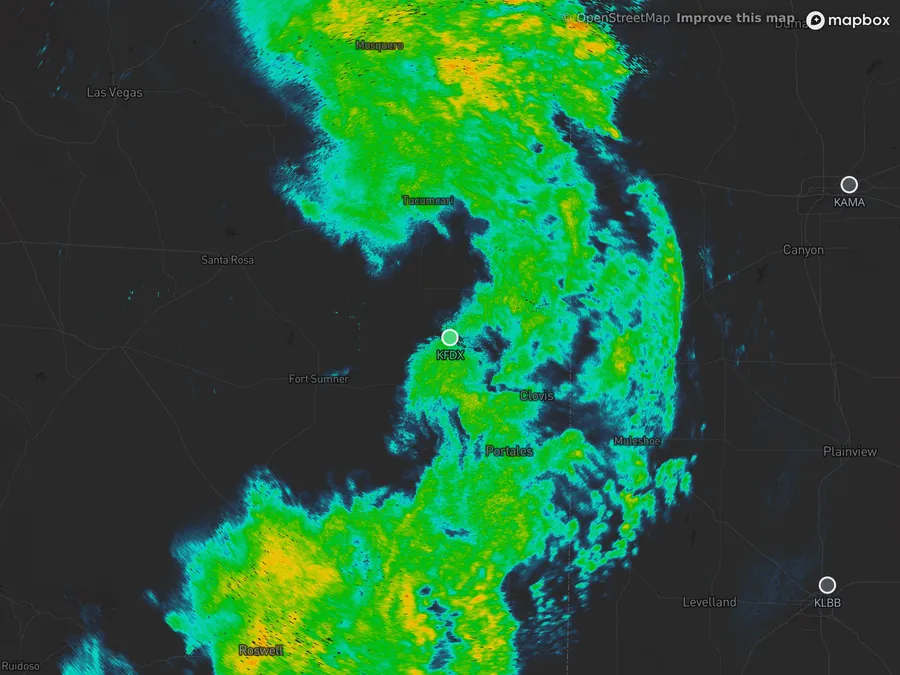
- KFDX Cannon AFB
- 1:40 AM MDT, Oct 25, 2026
- Reflectivity
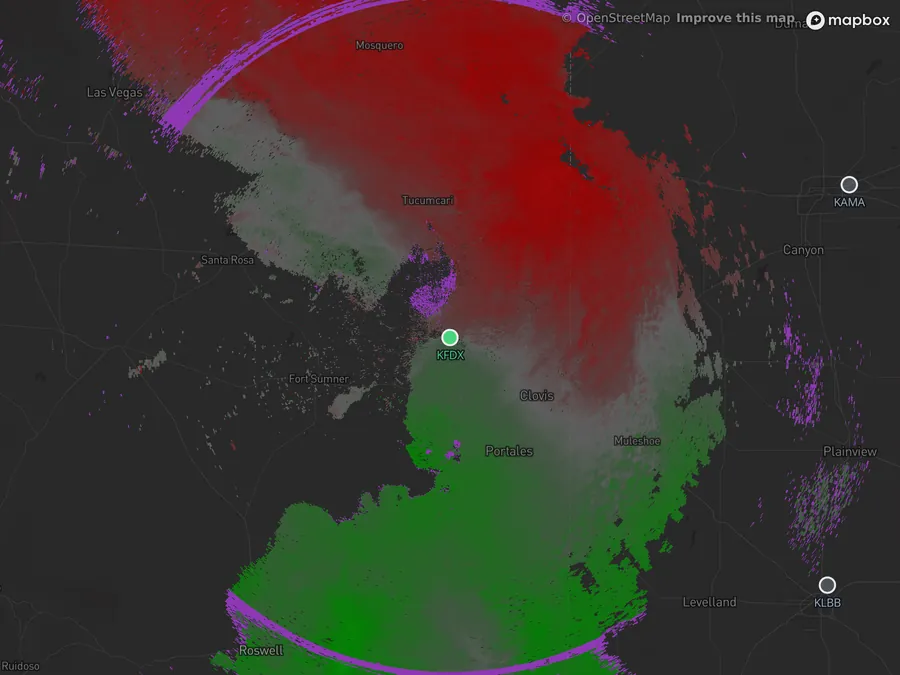
- Velocity
- 1The radar
- 2Green: toward the radar
- 3Red: away from it
- 4Gray: across the beam
- 5Purple: range folded
What the Doppler effect measures
An ambulance siren sounds higher as it comes toward you and lower as it moves away. Radio waves do the same. An echo from rain moving toward the radar comes back at a slightly higher frequency, and from rain moving away, slightly lower. That is the Doppler effect, and it is how a weather radar measures wind.
The shift is tiny. The US radars transmit at about 2.8 billion cycles a second, and rain moving at 30 mph shifts the echo by about 250 cycles a second, one part in eleven million. So the radar compares the echoes of successive pulses instead: rain that moved between two pulses sends its echo back a little earlier or later in the wave’s cycle, and that change gives the speed.
The result is velocity, the radar’s second view beside reflectivity. On Alerua, as on most radar maps, green is moving toward the radar and red is moving away, and the scale on the map gives the speed for each shade.
Only toward or away
The radar can only measure the part of the motion that points straight at it or straight away. Wind blowing across the beam reads zero however strong it is. So a steady wind draws a pattern: green on the side it comes from, red on the side it is heading to, and a gray strip through the radar where it crosses the beam.
Around the Cannon Air Force Base radar at the top, the pattern puts the wind out of the southwest at about 35 mph. The beam climbs as it travels, so rings farther from the radar read the wind higher up: here it turns more southerly with height, between about 1,000 and 3,000 feet.
Why velocity has a speed limit
The radar times each echo by waiting for it before it sends the next pulse. To measure speed it wants the opposite, pulses close together, so the rain cannot move far between them. The two pull against each other.
Sent 1,000 times a second, pulses let the radar hear echoes from about 93 miles away and read speeds up to about 60 mph toward or away. Past that the reading wraps around, so a 70 mph wind away from the radar shows as 50 mph toward it. That is velocity folding. The radar’s software unfolds most of it, and the most violent storms still tend to look scrambled. Slower pulses would reach farther and lower the speed limit.
An echo from beyond that distance comes back after the next pulse has left, and the radar cannot tell which pulse it belongs to. Rather than guess, it marks the spot purple: range folded. That is why purple shows on velocity and not on reflectivity. On the lowest tilts the radar scans twice, once with slow pulses to see far and once with fast pulses to measure speed, and only the fast scan folds.
Rotation and outflow
Green right beside red across the beam is air turning. Tight and bright, it is one of the three signs of a tornado. Green beside red along the beam is air rushing together or apart: a gust front, or a downburst spreading out at the ground.
Keep reading
- Severe weatherHow to spot a tornado on radarThe hook echo, the rotation pair on velocity and the debris signature.
- 3D radar3D weather radar, explainedHow a 3D view is built from the radar’s tilts, what it shows that a flat map can’t, and where it can mislead.
- Dual-polarizationDual-polarization radar, explainedCorrelation coefficient, differential reflectivity and KDP, and how they tell rain from hail, debris, birds and insects.
Further reading
- NOAA JetStream: radar images, velocity
- NOAA JetStream: how radar works
- NEXRAD Level II data on the Registry of Open Data on AWS
Radar data from NOAA’s live NEXRAD feed. Base map © Mapbox © OpenStreetMap contributors.